
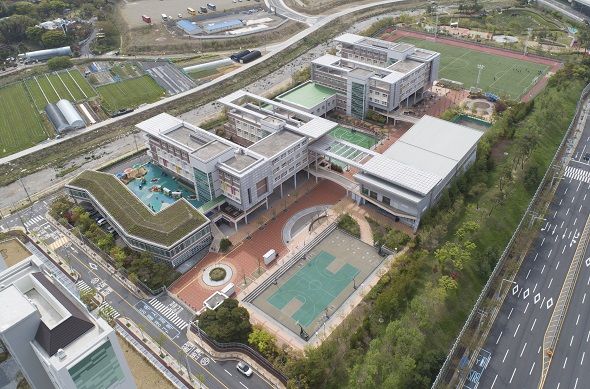
 On weekday mornings in Jeju’s Global Education City, students stream into sprawling campuses offering the International Baccalaureate, British A-levels and American high school diplomas.
Classes are conducted almost entirely in English with college counselors specializing in US and UK college admissions — far removed from the pressures of Korea’s grueling college entrance exam, Suneung.
But for most Korean families, this world remains legally out of reach.
South Korea’s foreign and international schools, long marketed as symbols of global education, are governed by some of the country’s most rigid and least understood rules. At their core is a question that extends beyond schooling: Who is allowed to opt out of the Korean system, and who is not?
A tightly regulated exception
Under Korean law, these institutions are officially categorized as “foreigner schools,” which are primarily intended for children of foreign nationals residing in the country. The law clearly defines who can and cannot attend them.
To be eligible for enrollment, students must either be foreign nationals, have attended school abroad for at least six semesters or have at least one parent who is a foreign national, according to the Elementary and Secondary Education Act. These criteria are subject to quota-based exceptions for Korean nationals.
“Up to 30 percent of an international school’s maximum admissions can be filled by Korean students who have lived abroad for three years,” an Education Ministry official explained. “Depending on city or provincial ordinances, the proportion can be raised to as high as 50 percent.”
Schools that violate the rules face escalating penalties. A first violation can lead to a six- to 12-month suspension of Korean student admissions or a corrective order for the school. A second offense may result in a 12- to 24-month suspension, a third in a 24- to 36-month suspension, and four or more violations in a ban on admitting Korean students for up to 10 years.
Easing hurdles
Admissions rules for foreign schools are stipulated under the Elementary and Secondary Education Act. In principle, local governments cannot enact ordinances that establish admissions criteria that conflict with higher-level laws.
However, the situation changed in April, when revisions to the Special Act on the Promotion of Research and Development Special Zones came into effect. Under the amended law, city councils are now allowed to set, through local ordinances, eligibility criteria for the admission of Korean nationals to foreign schools located within research and development special zones.
Despite tight regulations, Korean nationals accounted for 64 percent of enrolled students at Daejeon Foreign School as of September.
The figure comes after the Daejeon Metropolitan City Council passed an amendment in June, which scrapped the 3-year living abroad requirement and expanded the Korean national quota from 30 percent to 50 percent.
Local governments argue that easing admissions requirements is essential for attracting international talent.
“(Amending the ordinance) aligns with improving Gwangju’s educational environment and attracting more research personnel after it was designated as a research and development special zone,” said a Gwangju Metropolitan City Council member after the city passed a similar ordinance in October.
Schools have echoed those calls.
In December, Atherton International School in Geoje, South Gyeongsang Province, issued a statement urging local council members to raise the Korean student quota.
“Despite offering top-tier international education with a student body that is 95 percent foreign, Atherton is unable to meet local parents’ demand under the current regulations,” the school said.
“The law fails to reflect regional characteristics and educational demand,” it added, arguing that international schools could help revitalize local economies, boost population growth and attract key corporate workers.
Mounting concerns about ‘fairness’
Gwangju Metropolitan City Council drew backlash from civic groups after easing regulations in October.
The civic education group Citizens’ Coalition for Equal Education has called for the ordinance to be scrapped, arguing that it could undermine the public nature of education by creating “elite schools” for the children of high-income Korean nationals.
Similar concerns were first raised in the early 2010s when lawmakers claimed that large chaebol families and celebrities were bypassing the law to enroll their children into international schools.
The group also noted that annual tuition at the Gwangju Foreign School amounts to around 20 million won ($13,500), a figure that accounts for more than one-third of the roughly 55 million won in average annual income for Korean workers, even before additional fees are factored in.
According to public data, annual tuition at international schools nationwide ranges from about 20 million to 60 million won.
The rise of alternative “global tracks”
In response to growing demand, Korean public and private schools have expanded IB programs, English immersion classes and globally oriented curricula. Officials say these initiatives are intended to bring international education into the Korean system.
However, critics say the initiatives do not fit into Korea’s education system, which “focuses heavily on college admissions.”
“It is a huge burden for students to prepare for the IB diploma assessments in November, when they have to simultaneously prepare for Suneung (in November),” said Gyeonggi Provincial Assembly Member Jang Yoon-jung during a November audit of the Gyeonggi Education Office.
Jang cited the fact that only 10 students signed up for the IB program at a school in Anseong. “For students at regular (Korean) high schools, where college admissions is the absolute focus, making them prepare for both is a crucial problem.”
Families caught in between
For mixed-heritage families, overseas Koreans and returnee students, the rules often produce confusion and frustration.
A 54-year-old Korean parent surnamed Seo, who spent more than a decade abroad, said her child, educated entirely in English, was unable to attend an international school after returning to Korea.
“When we moved back, we looked into international schools. But because the quota for overseas Koreans is so small, we were unable to find a spot for my daughter,” Seo said.
“It didn’t matter that my child could barely read Korean textbooks.”
Seo’s daughter eventually graduated from a Korean high school in 2019 — opting out of Suneung — and took a gap year to prepare for admissions to American universities.
“I sometimes think about how things would have played out if we hadn’t moved back,” Seo said.
- Long-delayed destroyer project shifts to competitive bidding
- Korea cuts E-9 visa quota to 80,000 for 2026
- ARKO Selection begins 18th year, continues its role as platform for new works
- Jennie unveils hangul veil at MMA 2025, spotlighting Korean aesthetics through Le Je
- Closing out K-pop 2025: Stray Kids dominate, girl groups soar








Most Commented