
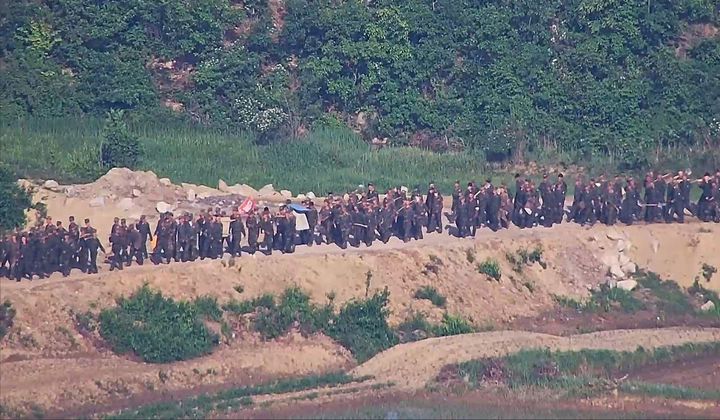
 South Korea’s Joint Chiefs of Staff confirmed Monday that frontline units received a revised internal guideline on how to determine Military Demarcation Line violations, amid a recent rise in North Korean troop incursions inside the Demilitarized Zone.
The guideline circulated in September allows the military to apply a line drawn farther south in cases where South Korean military maps and United Nations Command standards do not align.
At a regular Defense Ministry briefing, JCS spokesperson Col. Lee Sung-jun said the measure has been in effect since last year..
“Our military has prioritized MDL markers identified on the ground since last year,” Lee said. “In areas where markers are not clearly identifiable, we are taking action based on a comprehensive judgment that considers both the MDL on military maps and the line connecting UNC MDL marker coordinates.”
The JCS confirmation came hours after local daily Chosun Ilbo reported that the military had circulated a revised guideline that changed how MDL violations by North Korean troops are assessed.
According to the JCS, the updated instructions tell units to prioritize on-site MDL markers when they are clearly identifiable.
However, in areas where markers are missing or unclear, units are instructed to make a comprehensive assessment, considering both the MDL shown on South Korean military maps and a line connecting MDL marker coordinates used by the UNC.
If the two standards differ, the southmost line may effectively be used to determine a violation.
Lee added that the guideline was introduced “to ensure decisive responses by frontline units while preventing accidental clashes between the two Koreas in the event of armistice violations by North Korean forces inside the DMZ.”
The move has sparked criticism from the main opposition People Power Party, which denounced the revised MDL guideline on Monday, calling it an act of “self-sabotage of national security” by the Lee Jae Myung administration.
In a statement, senior party spokesperson Rep. Park Sung-hoon said the revised guidelines amounted to “ceding territory” and could create confusion and security gaps along the front line.
Park also claimed that MDL crossings by North Korean troops increased following the September circulation of the guideline, arguing that the policy sends “the wrong signal” to Pyongyang.
People Power Party Rep. Na Kyung-won echoed the criticism in a Facebook post, questioning the logic of defaulting southward in cases of ambiguity and accusing the government of making the change without public disclosure or parliamentary consent.
Na urged the administration to withdraw the guideline, warning it would weaken deterrence on the Korean Peninsula.
United States Forces Korea Commander Xavier Brunson, who also heads the UNC, recently cautioned against politicizing the DMZ.
Speaking on a security-focused podcast on Friday, Brunson said the armistice agreement must remain the governing framework for all activities in the buffer zone, emphasizing that changes to access or operational rules should not undermine the legal authority of the armistice.
Brunson noted South Korea’s proposal for military talks on MDL clarification but stressed that all actions must adhere strictly to armistice provisions.
The South Korean military has worked since 2004 with the US National Geospatial-Intelligence Agency to align the MDL shown on original maps with actual terrain, applying updated data to its own military maps.
The UNC, however, set its reference MDL based on 1953 armistice-era maps and physical boundary stakes, resulting in discrepancies of several dozen meters in some areas.
North Korea has carried out fortification and construction activities inside the DMZ since April last year, following Pyongyang’s declaration in late 2023 that inter-Korean relations constitute a hostile “two-state” relationship. During these activities, North Korean troops have crossed the MDL 16 times since March, with 10 cases reported in November alone, according to South Korean officials.
In response to the increase, Seoul’s Defense Ministry last month proposed holding military talks with Pyongyang to discuss ways to clarify the MDL and reduce the risk of accidental clashes. North Korea has yet to respond to the proposal.
The MDL was established under the 1953 armistice agreement that halted the Korean War, with 1,292 boundary markers originally installed along the line. Due to decades of weathering and erosion, only about 200 markers are believed to remain identifiable today.
- Long-delayed destroyer project shifts to competitive bidding
- Korea cuts E-9 visa quota to 80,000 for 2026
- ARKO Selection begins 18th year, continues its role as platform for new works
- Jennie unveils hangul veil at MMA 2025, spotlighting Korean aesthetics through Le Je
- Closing out K-pop 2025: Stray Kids dominate, girl groups soar









Most Commented